
Precision nickel-alloy machining · GCC supply
Monel & Hastelloy machining for demanding service
PartsMake manufactures precision components in corrosion-resistant nickel alloys for energy, water and marine applications across the GCC. We machine Monel 400 and Hastelloy C276, and review Monel K500 requests subject to material availability and project requirements.
From refinery sour-gas treatment to high-pressure process systems and severe marine exposure, we plan around the alloy, part geometry, dimensional requirements and inspection documentation.
Send your drawing, material specification and operating conditions for a manufacturing review and quotation.
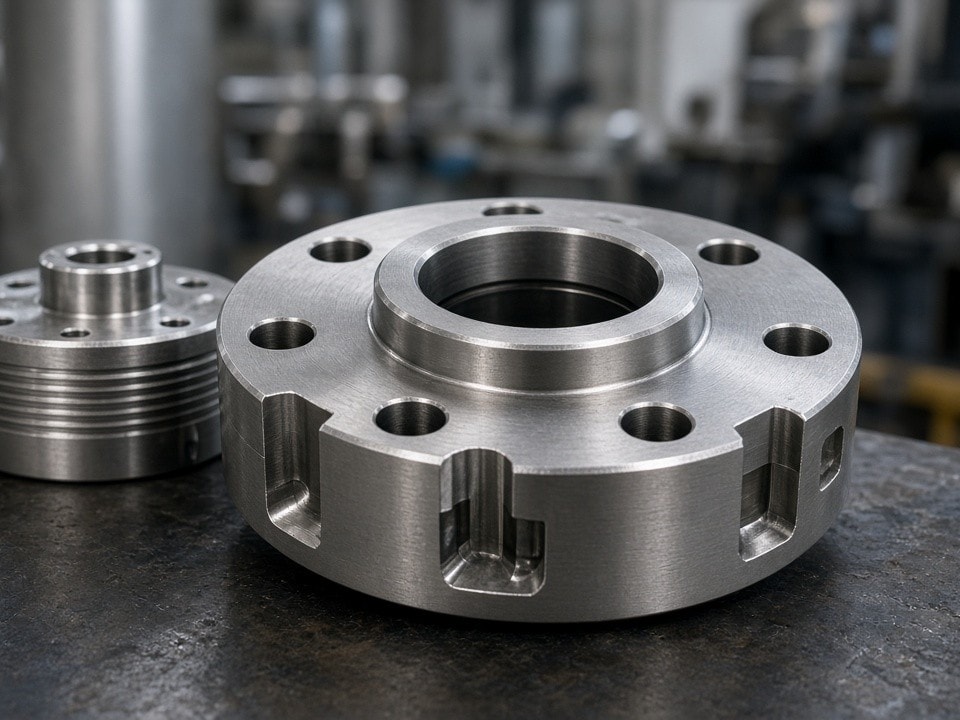
±0.002 mm
Precision capability on selected grinding and EDM operations
20,000 psi
Hydrostatic testing available, subject to part and procedure
Manufacturing capability
Machining planned around the alloy
Nickel alloys can work-harden during cutting, retain heat at the tool edge and develop residual stress as material is removed. Process planning considers alloy condition, geometry, stock allowance and required inspection—not only nominal drawing dimensions.
Figures below are process capabilities, not blanket guarantees. Achievable tolerances are confirmed after drawing, setup, material condition and measurement method review.
5-axis CNC milling
Work envelope up to 1,200 × 1,000 × 800 mm; standard machining tolerance to ±0.005 mm, depending on geometry and inspection requirements.
CNC turning
Parts up to Ø850 mm × 2,200 mm; standard tolerance to ±0.008 mm.
Mill-turn machining
Parts up to Ø420 mm × 1,050 mm; standard tolerance to ±0.005 mm.
Cylindrical grinding
Parts up to Ø400 mm × 1,500 mm; dimensional precision to ±0.002 mm.
Wire EDM
Work envelope up to 600 × 400 × 350 mm; precision to ±0.002 mm.
Surface grinding
Work envelope up to 1,600 × 800 × 500 mm; flatness and parallelism to ±0.003 mm.
Material selection
Monel 400, Monel K500 or Hastelloy C276?
The right grade depends on the full operating environment: chemical composition, concentration, temperature, pressure, flow velocity, contamination, weld condition and exposure duration. Final material selection should be approved by the project’s responsible materials or corrosion engineer.
Monel 400 for hydrofluoric acid and seawater service
This nickel-copper alloy is used in a range of marine and chemical-processing environments and is often considered for hydrofluoric acid service and seawater-exposed components. Performance depends on acid concentration, temperature, aeration, flow conditions and contaminants; seawater velocity, deposits and crevices also affect service life.
Typical drawing-based parts
Valve parts, pump and fluid-handling components, shafts, sleeves, flanges and bespoke fittings.
Monel K500 for strength-critical components
A precipitation-hardenable nickel-copper alloy that may be specified where greater strength is required alongside corrosion resistance. Suitability for a particular seawater or chemical duty must be checked against service conditions and applicable design requirements.
Availability to be confirmed
Not listed as a standard stocked material. Grade, condition, traceability and lead time are confirmed before order acceptance.
Hastelloy C276 for mixed corrosive media
Specified for demanding chemical environments that may involve both oxidising and reducing conditions. It is used for process internals, valve components, nozzles and fluid-handling parts where corrosion resistance is a key design consideration.
Traceable manufacture
Components are machined to the specified geometry, with material traceability and dimensional inspection records available as required.
Applications
Parts for refinery, process and marine projects
We support GCC engineering contractors, MRO providers, skid packagers and industrial distributors with custom and replacement components.
Acid-gas and sour-gas treatment
Internals, nozzles, valve components and other parts for refinery desulphurisation and gas-treatment equipment. Verify the specified alloy against process chemistry and applicable sour-service requirements.
High-pressure hydrogenation systems
Fittings, valve bodies, manifolds and other drawing-controlled components. Pressure-boundary design and material suitability remain subject to applicable codes and engineering approval.
Seawater and desalination
Pump, valve and fluid-handling components for warm, chloride-rich Gulf and Red Sea service.
Marine splash-zone equipment
Custom parts for severe coastal exposure. Service life depends on design, crevice control, surface condition, joining details and maintenance as well as alloy choice.
MRO and replacement work
Reverse-engineered or drawing-based components for delayed supply routes, subject to available material identification and engineering information.
Process control
Control distortion, work-hardening and edge quality
A successful nickel-alloy part depends on more than nominal machine accuracy. We review geometry and machining sequence to reduce avoidable stress, movement and finishing issues.
01 · Machining strategy
Manage heat and material movement
Where the part allows, we use rigid workholding, suitable tool engagement and controlled cutting parameters to manage heat and work-hardening. Roughing and finishing are planned around the component geometry, with staged material removal or a rest period between operations where appropriate.
Thin walls, long shafts, interrupted cuts and asymmetric stock removal receive particular attention because they can increase deflection or distortion. Critical features can be reviewed for machining allowance, datum strategy and inspection sequence before production.
02 · Deburring and finishing
Define edges for fit and function
Burrs can interfere with assembly, damage seals or become a source of local stress. We define edge requirements against the drawing and application, then select a controlled method such as manual deburring, abrasive finishing, precision grinding or EDM where applicable.
- Ports and passages: Cross-holes, slots and intersecting features.
- Mating areas: Seal lands, threads and contact faces.
- Delicate geometry: Thin edges and small features where aggressive finishing could change dimensions.
- EDM-cut details: Specified finish or recast-layer treatment where required by the drawing.
Include any required edge break, burr limit, surface finish or cleaning method in your RFQ so we can confirm inspection and recording requirements.
Quality evidence
Inspection, traceability and documentation
GCC operator and EPC supply chains often require clear evidence that parts meet the drawing and material specification. Tell us the document index, acceptance criteria and inspection hold points at quotation stage.
Material certification
EN 10204 3.1 certificates linked to heat or lot identification.
Positive Material Identification
PMI by XRF or OES, as required.
Dimensional inspection
CMM reports for specified dimensions and geometric features.
Non-destructive testing
Liquid penetrant, magnetic particle and ultrasonic testing, where applicable.
Pressure and finish records
Hydrostatic pressure testing up to 20,000 psi (1,380 bar), subject to the part, test setup and agreed procedure, plus surface-finish and other inspection records defined in the order.
Regional supply
GCC delivery and project support
We work with customers and project teams in Saudi Arabia, the UAE, Qatar and wider Middle Eastern industrial corridors. DDP delivery may be arranged to Dammam, Jubail, Riyadh, Dubai, Abu Dhabi and Doha, subject to destination, shipment details and agreed commercial terms.
For Saudi-bound shipments, we can coordinate applicable SABER/SASO conformity documentation and customs requirements. Share the destination, importer details and project-specific shipping instructions with your RFQ so we can confirm the route and documentation before dispatch.
Before placing an order, align on:
- 01Exact grade and condition: Monel 400, Monel K500 or Hastelloy C276, including heat treatment or mechanical-property requirements.
- 02Operating environment: Chemical composition, concentration, temperature, pressure, flow velocity and exposure conditions.
- 03Design and compliance: Applicable pressure, sour-service, welding, inspection or end-user specifications.
- 04Part definition: Current drawing and revision, critical dimensions, tolerances, surface finish and edge requirements.
- 05Documents and delivery: Certificates, inspection records, quantity, destination and target date.
We review manufacturing feasibility and documentation requirements. Corrosion, pressure-boundary or code suitability must be confirmed by the project’s responsible engineering authority.
Request a quotation
Is a Monel or Hastelloy component right for your project?
Send your 2D drawing or 3D model, alloy grade, quantity, operating conditions and inspection requirements. For an obsolete replacement component, include any available sample measurements, material markings or service history.
Our team will review the manufacturing route, identify information needed to quote accurately and confirm material availability and delivery options.
You can also contact us at info@partsmake.ae. Any corrosion, pressure-boundary or code suitability decision should be confirmed by the project’s responsible engineering authority.
Share your project requirements
Include the drawing revision, specified grade and required certificates or inspection records for a more accurate review.
PartsMake
Address: