
Low-volume injection moulding
Low-Volume Plastic Molding for 500–20,000 Parts
PartsMake supports dependable plastic components without a long-run production commitment. Choose a tooling route around your part, resin, batch size and delivery schedule.
From industrial IoT enclosures and valve handwheels to electrical instrument housings, we help plan production for functional parts destined for GCC equipment and service environments.
500–20,000
Parts per production batch
7–25
Business days to first shots, by tooling route
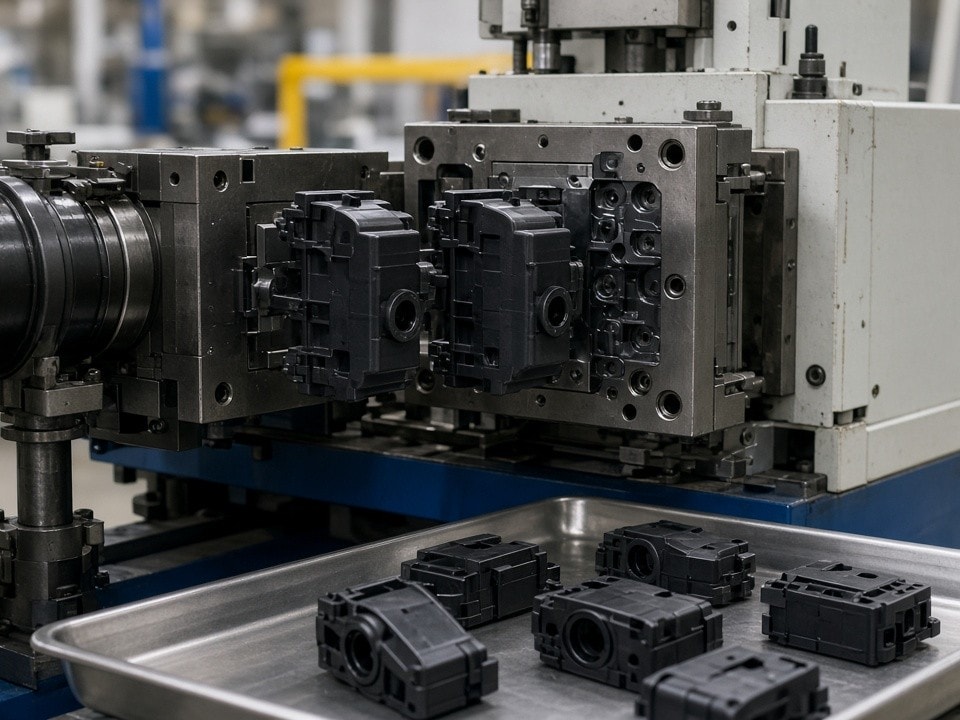
A practical production route for your next batch
Discuss resin selection, modular tooling, first-shot checks and delivery planning with your drawing or 3D model.
Molding capacity
Match the process to the part and resin
We provide rapid tooling, engineering polymer moulding and elastomer compression moulding for prototype validation and small-to-medium production batches. First-shot lead times depend on part complexity, resin availability, tooling design and drawing approval; we confirm the proposed schedule during quotation.
01 · Rapid prototype injection moulding
A quick route to first shots
- Tooling
- Aluminium 7075 or pre-hardened P20
- Capacity
- 50–450 ton clamp force; part weights from 1 g to 1,800 g
- First shots
- 7–14 business days
- Materials
- ABS, polycarbonate, POM-C, PA66+GF30
02 · Engineering polymer moulding
For demanding resin grades
- Tooling
- Hardened H13 or S136 tool steel
- Capacity
- 80–850 ton clamp force; parts up to 3,200 g
- First shots
- 15–25 business days
- Materials
- PEEK, PPS, PVDF, glass-filled nylon
03 · Elastomer compression moulding
For flexible components
- Tooling
- Precision multi-cavity tooling
- Capacity
- 100–300 ton clamp force
- First shots
- 10–15 business days
- Materials
- FKM, HNBR, FFKM, high-temperature silicone
Modular tooling
Keep variant tooling practical for smaller batches
A dedicated full tool is not always the best fit for a 500-, 2,000- or 10,000-piece order. Where the geometry permits, a modular mould base with interchangeable cores can use one common base for related part variants.
This can reduce the tooling cost allocated to each variant and make repeat or revised orders more practical. Feasibility depends on the part design, resin, expected production volume and changeover requirements.
Where interchangeable cores may help
-
Industrial IoT devices
Shared internal architecture with different enclosure features.
-
Instrument housings
Multiple connector or display configurations.
-
Valve handwheels
Different sizes or hub details across a product family.
-
Electrical covers and cases
Customer-specific cut-outs or mounting points.
Modular tooling is not suitable for every geometry. For a single high-complexity part, a dedicated tool may offer a better balance of cost, cycle time and dimensional control.
Dimensional control
Plan for shrinkage and warpage in engineering plastics
Moulded parts can move as they cool. Higher-shrinkage materials such as PA66+GF30 can show fibre-related directional behaviour, while PEEK also needs careful attention to processing conditions and tool design. Warpage may affect flatness, assembly fit, sealing faces and mounting-feature alignment.
We review the resin grade and part requirements before tooling, then agree critical-to-function dimensions and the inspection approach for first shots and production.
Design and process considerations
- 01Wall-thickness consistency, ribs, bosses and transitions
- 02Gate location and material flow effects on fibre orientation
- 03Cooling layout and temperature balance across the part
- 04Draft, parting lines and ejection points
- 05Critical dimensions, flatness and assembly interfaces
- 06Application resin grade and its processing requirements
First shots allow the team to check fit and key dimensions, identify moulding issues and confirm the production route before the main batch proceeds. Inspection methods depend on component geometry and drawing requirements.
Regional applications
Parts for GCC industrial equipment
We mould functional components for equipment used across Saudi Arabia, the UAE, Qatar and the wider Middle East. Resin selection should reflect the actual temperature, chemical and UV exposure, mechanical loading and electrical requirements.
Industrial IoT terminals
Sensor housings, communication device cases and protective covers.
Valve and flow-control equipment
Plastic handwheels, actuator covers, knobs and non-pressure-bearing components.
Electrical and instrumentation assemblies
Meter housings, switchgear covers, terminal enclosures and mounting features.
Water and process equipment
Polymer components for meters, flow instruments and chemical-system assemblies.
Field-service equipment
Replacement or revised plastic components when standard supplier lead times do not suit the maintenance schedule.
For outdoor or hot-service use, include operating temperature and environmental exposure in your RFQ. Application performance depends on the selected grade, part design and service conditions.
Project workflow
From design review to documented delivery
A clear review and production plan helps make low-volume orders easier to evaluate and procure.
-
01 · Review
Drawing and application
Check the 2D drawing or 3D model, resin specification, critical features and intended operating conditions.
-
02 · Recommend
Tooling strategy
Compare rapid tooling, hardened production tooling and modular-core options against batch size and repeat orders.
-
03 · Plan
First-shot requirements
Confirm tooling schedule, sample requirements and inspection points before production starts.
-
04 · Produce
Batch and inspection
Mould the agreed batch and verify specified dimensions using an inspection plan suited to the component.
-
05 · Deliver
GCC shipment coordination
Coordinate delivery to regional destinations, with DDP options and customs coordination subject to shipment and product requirements.
Dimensional inspection records and material documentation can be provided when requested, as appropriate to the resin and project specification. EN 10204 3.1 certificates apply to metallic raw materials and are not a substitute for polymer resin documentation.
Production fit
Is low-volume moulding the right route?
Injection moulding is often a good fit for repeatable parts with consistent geometry when you need at least several hundred components. It can be especially useful for integrated ribs, bosses, clips or other features that would be costly to machine individually.
Discuss your production routeConsider another route if
- You need only a handful of prototypes and the design is still changing substantially.
- The part is oversized for the available moulding envelope or press capacity.
- A metal component is required for structural, thermal or pressure-bearing reasons.
- The application requires a qualification programme beyond the project scope.
If your design is still under review, we can discuss whether a prototype tool, polymer 3D printing or another manufacturing route is more suitable before you commit to production tooling.
Request a low-volume molding quote
Send us your drawing or 3D model
We will review the part, tooling approach, estimated lead time and documentation requirements for your project, including delivery planning to your GCC site.
To help us prepare a useful quotation, include:
- 2D drawing and 3D CAD file, if available
- Resin grade or required material properties
- Initial order quantity and estimated repeat volume
- Critical dimensions, tolerances and inspection requirements
- Operating temperature and exposure to chemicals, UV, moisture or sand
- Colour, finish, marking and packaging requirements
- Delivery destination and requested date
Company address
Common questions
Low-volume molding FAQs
What batch sizes do you support?+
We focus on 500 to 20,000 parts for low-volume and medium-volume injection moulding. The practical batch size depends on the part, resin, tool design and whether future repeat orders are expected.
Can you mould PA66+GF30 and PEEK?+
Yes. PA66+GF30 is included in the rapid tooling material range, while PEEK is supported with hardened tooling. Tool and process planning should account for the specific grade and part geometry, particularly where shrinkage, fibre orientation or flatness affects fit.
How can modular cores reduce tooling cost?+
For compatible part families, a common mould base can be paired with interchangeable cores for different cavity details. This can avoid building a completely separate tool for every variant. Savings depend on the design and tooling scope.
How long does tooling take?+
Stated lead time to first shots is 7–14 business days for rapid prototype tooling and 15–25 business days for hardened engineering-polymer tooling. Complexity, material selection, design changes and approval timing can affect the actual schedule.
Can you deliver to Saudi Arabia, the UAE and Qatar?+
We serve GCC destinations and can coordinate DDP delivery and customs logistics, subject to shipment details and applicable product requirements. Share the destination and required delivery date with your RFQ.