
Thermal stabilisation for critical components
Stress Relieving & Annealing for Dimensional Stability
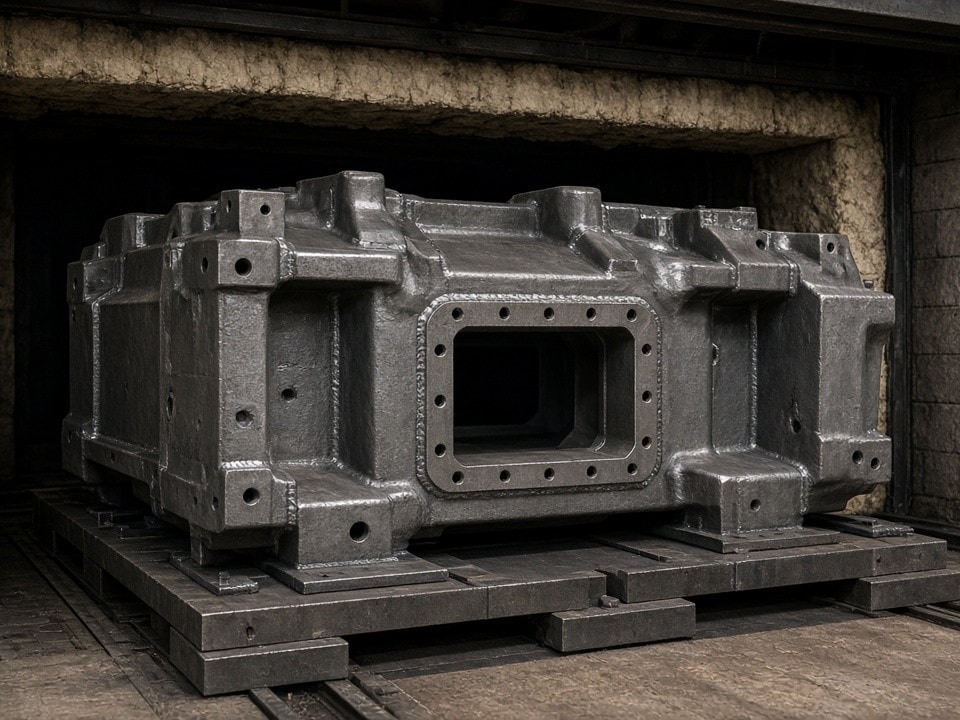
After rough machining, large structural parts and thin-walled, deep-cavity precision components can retain internal stresses that lead to distortion. PartsMake uses controlled vacuum furnace cycles to help release those stresses and protect dimensional stability through the repeated day-to-night temperature swings of the Middle East.
From valve bodies and turbine housings to heavy-duty skids, each thermal cycle is tailored to the component’s material, geometry and manufacturing stage.
2,000 mm
Maximum component length
±0.5°C
CMM suite temperature control
3.1
EN 10204 documentation available
Why stress relief matters
Reduce the risk of thermal-cycle distortion
Heavy milling, turning and welding can leave residual stresses within a metal’s structure. If untreated, these stresses may contribute to warping or cracking when components encounter the heat, pressure and temperature cycling common in oil and gas, desalination and energy infrastructure.
Our controlled-atmosphere vacuum furnace protocols are developed for GCC-relevant alloys, including Inconel 718, Super Duplex 2507 and AISI 4140. Processing after rough machining helps bring parts closer to dimensional equilibrium before finish machining or installation.
Large, heavy structures
Stress-relief cycles for welded skids and substantial machined components.
Thin walls and deep cavities
Gradual thermal transitions for complex sections vulnerable to uneven expansion.
Controlled thermal cycles
A carefully managed path from heat-up to cooling
There is no one-size-fits-all cycle. Furnace parameters are selected to suit the alloy, cross-section and geometry of each part.
Gradual, multi-stage ramp-up
Controlled heating helps limit thermal shock and uneven expansion. This is particularly important for deep-cavity manifolds, thin-walled precision parts and other complex geometries.
Uniform temperature through the section
A defined isothermal holding period allows the component’s cross-section to reach a consistent temperature and supports a stable, repeatable thermal process.
Managed descent with staged slow cooling
Carefully controlled cooling gradients help avoid reintroducing stress, allowing the material to settle towards a more neutral state and reducing the risk of future deformation.
Vacuum annealing
Protect alloy surfaces as well as part geometry
For sensitive materials such as Hastelloy, titanium and stainless steels, vacuum annealing helps reduce oxidation, scaling and surface contamination associated with conventional heat treatment.
-
Bright annealing
Helps maintain finishes on precision-machined internal channels and seal interfaces.
-
Surface integrity
Helps limit depletion of alloying elements such as chromium, important to corrosion resistance in high-salinity seawater service.
-
Hydrogen service considerations
Vacuum-cycle degassing can support components intended for hydrogen service or high-pressure sour gas environments (H₂S).
Capacity & workflow
Built for complex geometry and demanding throughput
Industrial vacuum furnaces accommodate components up to 2,000 mm in length, including long wellhead mandrels, large heat exchanger tube sheets and heavy-duty pump shafts.
Integrated multi-stage processing
Coordinate machining, intermediate stress relief, final finish machining and final stabilisation within one manufacturing workflow—so parts can be prepared for installation with fewer process hand-offs.
Verification & traceability
Dimensional checks after treatment
Post-treatment metrology compares pre- and post-process dimensions to help verify that components have reached dimensional equilibrium.
Measurement environment
20°C ± 0.5°C
Temperature-stabilised CMM inspection suite.
Project documentation
EN 10204 3.1, when required
Furnace charts, time-temperature logs and CMM dimensional reports can be included in the final data book.
Documentation supports quality review against regional operator requirements, including those of Saudi Aramco, ADNOC and SABIC.
Application-specific thermal solutions
Match the thermal objective to the component
Cycle planning considers component geometry, alloy and the dimensional or service outcome required.
| Component type | Material | Thermal objective |
|---|---|---|
| Valve bodies / trims | Inconel 625 / 718 | Reduce machining stress that can contribute to seat leakage. |
| Pump impellers | Super Duplex 2507 | Stabilise the structure to help prevent dynamic imbalance. |
| Structural skids | Carbon steel / SS316 | Relieve weld stresses and reduce cracking risk under vibration. |
| Sensor housings | 17-4PH / 316Ti | Support dimensional stability for accurate electronic fitment. |
Plan your thermal process
Review material, geometry and machining sequence with our engineers
For specialised heat treatment or thermal stabilisation, our engineering team can review your specifications and provide rapid DFM feedback before production begins.
Technical enquiries
Share CAD files, material grades and key tolerances for an initial assessment.
Facility visits
Site inspections can be arranged at our regional headquarters:
Engineering contact: info@partsmake.ae
Request a technical consultation
Tell us about the component, alloy and dimensional requirements. Our team will help assess the right next steps.