
Industrial additive manufacturing · UAE & GCC
High-Temp Polymer 3D Printing for GCC Industrial Parts
PartsMake produces industrial polymer 3D-printed components in PEEK, PEKK, ULTEM 9085 and other engineering plastics for equipment integrators, MRO contractors and industrial suppliers across the UAE and GCC.
Use tooling-free production for prototypes, replacement components and low-volume batches. For urgent switchgear or deep-well instrument repairs, send your drawing and service conditions for a manufacturability review—material suitability and delivery timing are confirmed for each requirement.
600 × 600 × 600 mm
Maximum build envelope
Up to 220°C
Heated chamber
No mould required
For prototypes and low volumes
Built for application-specific review
For parts specified above 250°C or to UL 94 V-0, we review the exact resin grade, geometry, operating conditions and acceptance criteria before confirming suitability.
Where it fits
Specialist parts for demanding industrial service
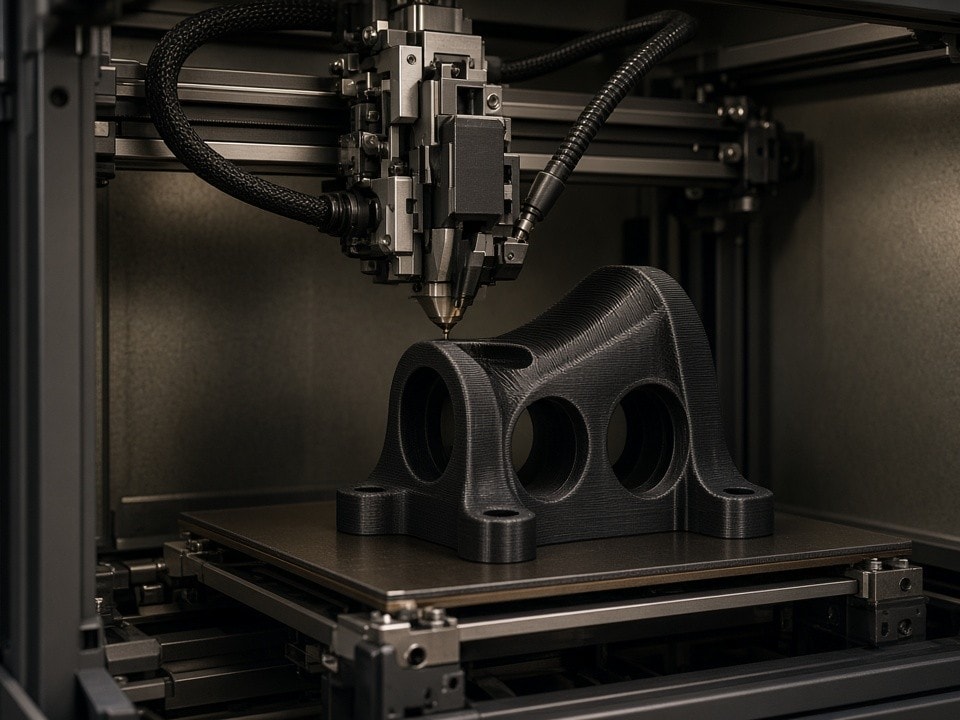
Industrial FDM builds thermoplastic components layer by layer. It can make complex geometries without dedicated tooling, making it useful for replacement needs and small batches where a mould may be uneconomical or unavailable.
01 · Power systems
Switchgear insulation & arc barriers
Assess custom arc barriers, insulating dividers, brackets, supports and enclosure features for high-voltage and ultra-high-voltage assemblies. Geometry, electrical requirements and any arc or flammability test criteria need to be reviewed together.
02 · Energy & downhole
Instrument supports & sealing frames
Review instrument supports, insulating features, centraliser components and high-temperature sealing-frame structures for deep-well applications. Share temperature, pressure, fluids, loading and service duration to assess the requirement.
03 · MRO & low-volume production
Tooling-free replacement when timing matters
A digital model can be printed without waiting for injection mould tooling. This may suit obsolete or damaged parts, fit checks, customised project batches and design updates. Each part remains subject to build-feasibility and application review.
Materials & process
Industrial FDM capacity for functional parts
We use industrial high-temperature FDM equipment rather than treating the process as general-purpose prototyping. Material selection matters as much as the printer: PEEK, PEKK and ULTEM 9085 have different thermal, mechanical, chemical and flammability properties.
Performance depends on the specific grade, print orientation, wall thickness, part design and operating conditions. A resin’s published rating is not a guaranteed rating for every printed component.
Materials considered
- PEEK: often considered for heat, wear and demanding industrial environments.
- PEKK: assessed where its particular material properties align with the application.
- ULTEM 9085: a high-performance thermoplastic option for engineering parts.
- Carbon-fibre PA: available for applicable component requirements.
Available grade and documentation are confirmed during quotation; material names alone do not replace application-specific validation.
Published process specifications
Critical dimensions and suitability are confirmed against the part geometry.
- Maximum build volume
- 600 × 600 × 600 mm
- Heated chamber
- Up to 220°C
- Typical layer thickness
- 100–300 μm
- As-built dimensional accuracy
- ±0.2 mm; confirm critical dimensions against geometry
- Listed materials
- PEEK, PEKK, ULTEM 9085, carbon-fibre PA
- Typical applications
- Electrical components, instrument structures, prototypes and replacement parts
For service above 250°C or UL 94 V-0 requirements
Tell us the required operating profile and compliance criteria. UL 94 V-0 is material- and thickness-dependent; confirm the selected resin and the relevant specimen or finished-part requirements rather than assuming the classification applies to every printed part.
Design for the build
Geometry, orientation and dimensional review
FDM parts are built in layers, so orientation can affect strength and surface finish. We review load-bearing features, wall thickness, supports and post-processing needs before production.
Orientation & loads
Identify load direction and functional faces so build orientation and layer direction can be considered during review.
Fits & interfaces
Provide drawing tolerances and mark critical dimensions, sealing surfaces and assembly interfaces. Tighter features may need a design adjustment or machining allowance, subject to feasibility.
Envelope & supports
The maximum build envelope does not guarantee that every part within it can be printed as drawn. Long, thin or highly featured parts may need a different orientation, supports or a split design.
Choose the right route
FDM, machining or moulding?
The right manufacturing path depends on part geometry, quantity, lead-time constraints and acceptance criteria—not just the material’s headline temperature rating.
High-temp FDM
Consider for complex parts, limited quantities, replacement needs or when tooling lead time is a constraint.
CNC machining
May suit accessible geometries machined from solid stock when dimensional control is the main priority.
Injection moulding
May be more suitable for higher-volume repeat production once the design and material are established.
Prepare your RFQ
Send as much of the following as available to help assess feasibility, material fit and inspection needs.
- 01CAD and drawing: 3D model, 2D drawing, units and revision.
- 02Material: preferred grade and any customer-approved source.
- 03Service conditions: continuous and peak temperature, chemicals, loads and expected life.
- 04Compliance: applicable standard, thickness and documentation expectations, including UL 94 V-0 if required.
- 05Critical interfaces: tolerances, sealing, fit and assembly requirements.
- 06Order details: quantity, delivery location and required date.
- 07Inspection and confidentiality: traceability needs for regulated or operator-controlled work, plus any confidential handling or labelling requirements.
Common questions
Review the requirements before production
For high-temperature, electrical or downhole service, application details help establish what needs to be checked before a quotation can be confirmed.
Can every printed part be rated for service above 250°C?
No general rating should be assumed. Suitability depends on the exact material grade, part geometry, print orientation, operating conditions and the required evidence. Share the service profile so these can be reviewed before confirming suitability.
Does UL 94 V-0 apply automatically to a printed component?
No. UL 94 V-0 is a material- and thickness-dependent classification. Include the applicable standard, specimen or finished-part thickness, and documentation expectations in your RFQ.
What should I provide for a downhole sealing-frame review?
Share the expected temperature profile, pressure, fluid exposure, loading, service duration and sealing-interface requirements, along with the CAD model and drawing if available.
Request a high-temperature polymer 3D printing quote
Send your drawing for a manufacturability review
Share your drawing, material specification and quantity. Our team will review build feasibility, material fit and any requirements that need confirmation before quotation. For urgent MRO or project work, include the site location and required delivery date.
For confidential designs, state any handling or labelling requirements when you submit your enquiry.
PartsMake
Address: