
Precision CNC machining · marine-grade surface treatment
Marine Passivation & Pickling for GCC Industrial Assets
Machining alone is not enough for components working in the Gulf’s high-salinity, high-temperature environments. PartsMake combines precision CNC manufacturing with controlled pickling and passivation to help protect critical stainless steel parts before they reach site.
Our post-machining process is aligned with ASTM A967 and ASTM A380, addressing microscopic free-iron contamination and supporting the formation of a dense, chromium-rich passive film for coastal and offshore service.
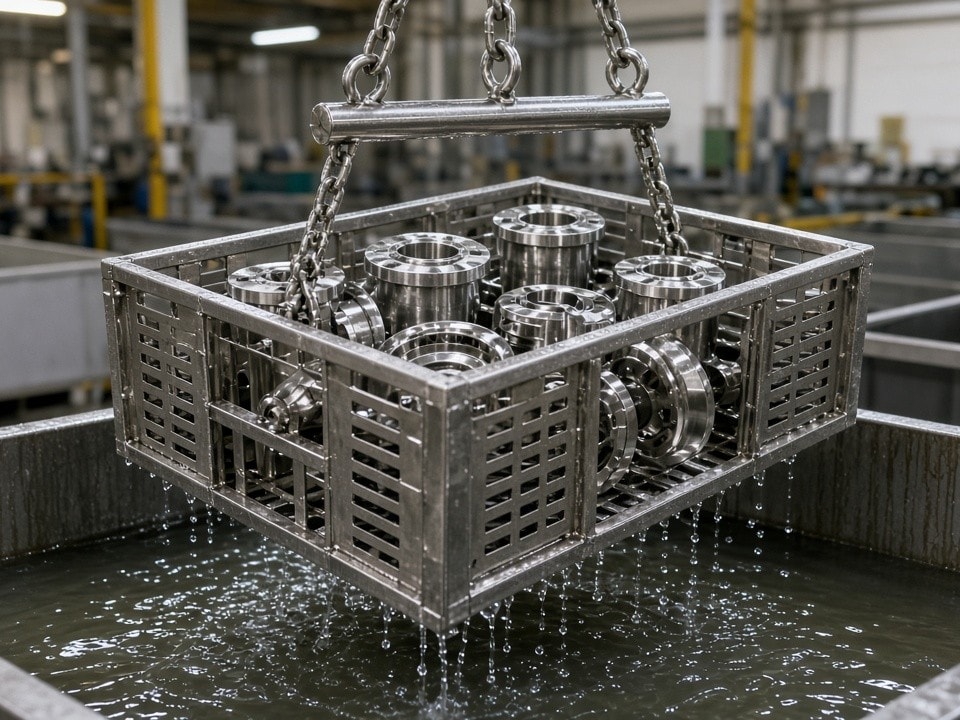
From machining to protected surface
A coordinated manufacturing and finishing route for valves, flanges, instrumentation housings and other critical components.
±0.005 mm
5-axis CNC milling tolerance
ASTM A967 / A380
Pickling and passivation standards
10–15 business days
Typical priority turnaround for finished parts
Why passivation matters
Stop free iron becoming the start of corrosion
Cutting tools and handling can transfer microscopic iron particles onto stainless steel. In humid, chloride-rich Gulf air, this contamination can become a local corrosion initiation site, contributing to tea-staining, pitting and red-rust spots.
A controlled post-machining treatment removes surface contamination and helps the stainless steel re-establish its chromium-rich passive layer—supporting longer service in desalination plants, offshore assets and coastal facilities.
The objective
Deliver a clean, consistent surface that is better prepared to resist chloride attack—not simply a machined part that looks clean to the eye.
Controlled preparation
Start with the machined surface
Parts are reviewed and prepared for the specified finishing route. Cleaning before chemical treatment helps remove oils and residues that could interfere with consistent surface conditioning.
Pickling · ASTM A380
Remove scale and surface contamination
A controlled nitric- or citric-based pickling route can remove weld heat-tint, scale and embedded surface iron contamination from stainless steel, helping restore a uniform surface condition.
Passivation · ASTM A967
Support a chromium-rich passive film
After free iron is removed, controlled passivation promotes the formation of a dense chromium-rich oxide layer at the surface. This passive film is the component’s first line of defence against oxidation and localised corrosion.
Inspection and records
Document the finished batch
Batch process confirmation can be supplied alongside material mill certificates and dimensional inspection records, giving project QC teams evidence for site acceptance and shipment review.
Treatment selection and verification are confirmed against the component material, geometry and project specification.
Integrated manufacturing
Machining, finishing and verification in one workflow
Surface conditioning is matched to the manufacturing route and the alloy, so parts are prepared for demanding Middle Eastern energy and water infrastructure.
| Process / capability | Standard / specification | Project benefit |
|---|---|---|
| 5-axis CNC milling | ±0.005 mm tolerance | Complex geometries with close-fit assembly |
| Marine-grade passivation | ASTM A967 / A380 | Removes surface iron and helps resist salt-spray pitting |
| Stainless steel pickling | ASTM A380 · nitric / citric routes | Removes weld heat-tint and scale for a more uniform finish |
| PMI verification | XRF spectrometry | Material grade verification, including 316L, 2507 and 17-4PH |
| Dimensional inspection | Zeiss CMM data books | Documented dimensional evidence for site acceptance |
Alloy expertise
Finishing routes for demanding materials
We machine and condition alloys used across regional energy, offshore and water infrastructure, with process choices aligned to the component and application.
Super Duplex 2507
Optimised machining parameters help preserve material integrity, followed by passivation to protect surfaces including weld-affected zones.
AISI 316L / 316Ti
Precision turning and milling for valve trims and fluid manifolds, with finishing selected to help resist chloride attack.
Inconel 625 / 718
High-tolerance machining for downhole components, with stress relief and chemical cleaning specified as required to support surface purity.
Built for GCC operations
Reduce corrosion-related disruption
-
Help prevent field failure
Removing free iron helps reduce the risk of tea-staining, pitting and red-rust initiation on stainless components in Arabian Gulf conditions.
-
Support longer service life
Controlled surface treatment can improve resistance to localised corrosion compared with untreated machined surfaces, helping reduce avoidable equipment change-outs.
-
Make QC review easier
Batch process records and inspection documentation support shipment review and site acceptance requirements.
A practical local manufacturing route for MRO and EPC requirements in Dammam, Jubail and Musaffah.
Regional supply support
Localised logistics, clear batch traceability
A local manufacturing partner can help reduce delays tied to overseas sourcing and move certified, passivated parts directly to your warehouse or project site.
-
01 · Delivery
DDP delivery support
Customs, SABER/SASO certification and local transport can be managed to reduce the administrative load on procurement teams.
-
02 · Traceability
A documented data book
Orders can include material mill certificates, CMM dimensional logs and passivation process confirmation.
-
03 · Turnaround
Priority replacement parts
Agile production can prioritise mission-critical requirements, with finished, passivated components often delivered in 10–15 business days.
Request a technical quotation
Send us your drawings or RFQ
If you need a local partner to machine and passivate stainless steel parts to international standards—or are addressing corrosion on offshore or industrial components—we are ready to review your project.
Email: info@partsmake.ae
Technical facility:
For a prompt technical review, include the required material grade, quantity, drawings and any specific NDT or inspection requirements.