
T2 copper busbars · GCC project supply
Busbars & Switchgear Hardware for High-Current Applications
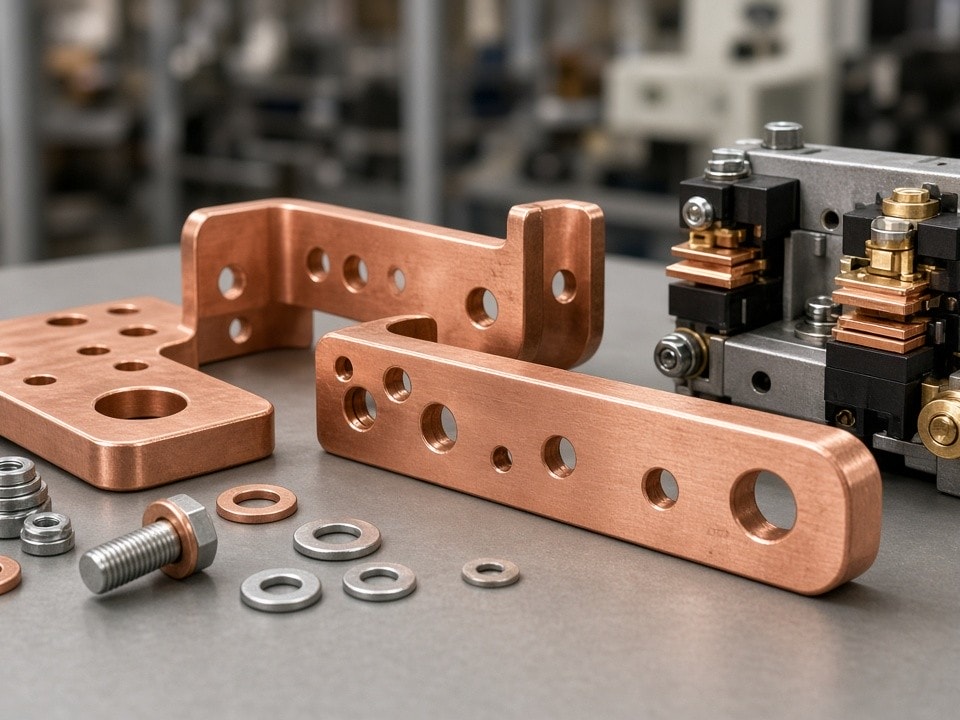
PartsMake manufactures precision T2 copper busbars and switchgear accessories for city grid upgrades, large-scale solar PV plants and hyperscale data centre substations across the GCC.
From accurate multi-plane bends to CNC-milled contact faces and protective tin or silver plating, each part is engineered to support low-resistance connections in demanding desert and coastal conditions.
4,000–12,000 A
Continuous current applications for grid and substation projects
Up to 250 × 20 mm
T2 copper bar width and thickness capacity
12–18 working days
Typical delivery for batches up to 200 pieces after drawing approval
Designed for regional conditions
High-current busbars for demanding GCC environments
Grid reinforcement projects in Riyadh, Dubai, Abu Dhabi and Doha require busbars capable of carrying 4,000 A to 12,000 A continuously, with ambient temperatures reaching 50 °C and exposure to airborne salts.
Oxidation at connection points can increase contact resistance and contribute to joint overheating. For this reason, procurement teams often define bend radii, milled overlap faces and plated surfaces before issuing an RFQ.
Joint surface control
Flat, machined lap faces support consistent contact across the overlap area.
Finish for the installation
Choose tin or silver plating to suit the project’s connection and exposure requirements.
Manufacturing and verification
Precision from copper bar to finished connection
A controlled sequence of forming, machining and inspection helps deliver repeatable dimensions and reliable contact surfaces for high-current assemblies.
T2 copper bending and forming
Oxygen-free T2 copper bar is formed in widths up to 250 mm and thicknesses up to 20 mm. CNC press brakes with custom tooling produce single-plane and multi-plane bends to ±0.3° angular tolerance and ±0.5 mm positional accuracy.
Spring-back compensation is calculated for each batch using material certificates, reducing the need for manual correction on site.
CNC-milled contact lap faces
Joint faces are milled on 5-axis machines to achieve flatness within 0.05 mm across the full overlap area. Machining removes rolling marks and oxide layers to create a uniform surface for current transfer.
CMM probes measure the faces, with results recorded in the inspection data book supplied with each shipment.
High-current holes and slots
Mounting holes and alignment slots are drilled or milled to customer drawings. Hole positions are held to ±0.2 mm true position.
For busbars above 6,000 A, chamfered hole edges help reduce local current density. Edge radii are verified before plating.
Anti-oxidation tin or silver finish
In-house plating helps control coating thickness and adhesion. Select the finish that aligns with your connection design and project requirements.
10–15 µm electro-tin
A protective finish option for busbars and switchgear components.
3–5 µm silver over a nickel strike
A plated joint option used on solar inverter skids to help minimise voltage drop.
Salt-spray testing to ASTM B117 confirms 1,000 hours without blistering or a measurable resistance increase. Finished parts ship in neutral packaging with laser-etched part numbers.
Project applications
Built around your installation
Share the drawing, current rating and operating environment so the busbar geometry and finish can be aligned with your equipment.
Discuss your applicationSolar PV plants
UAE and Saudi Arabia inverter skids use 4,000 A–8,000 A DC busbars, with silver-plated joints specified to help minimise voltage drop.
Hyperscale data centres
MV switchgear at NEOM and G42 facilities may require custom copper links with tight bend radii to fit compact panel layouts.
City grid upgrades
Dammam and Jubail projects specify tin-plated busbars for outdoor disconnectors exposed to H₂S and coastal humidity.
Traceability and inspection records
Supplied documentation includes EN 10204 3.1 material certificates, PMI reports and CMM dimensional records.
GCC delivery
Ready for regional project schedules
Delivery destinations
Parts leave the factory under DDP terms to JAFZA, DAFZA, KEZAD, Dammam or Doha yards.
Certificates and lead time
SABER and SASO certificates are processed before shipment. Typical lead time is 12–18 working days from approved drawing to site delivery for batches up to 200 pieces.
Request for quotation
Send us your busbar requirements
Share your drawings, current rating, preferred plating finish and delivery location. We aim to return a firm quotation with material traceability and an inspection plan within one working day.
For an accurate review, include the required bend radii, hole pattern and project schedule where available.