
Heat treatment for GCC oil & gas
Case Hardening & Nitriding for High-Wear Components
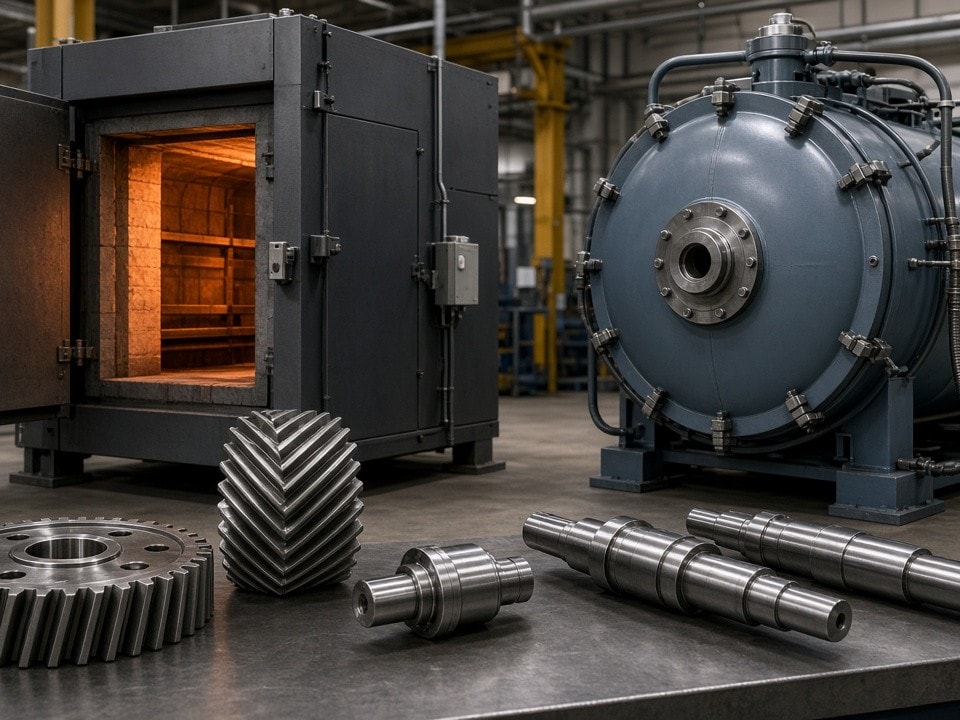
PartsMake operates dedicated lines for gas nitriding, plasma nitriding and carburising & quenching. We support demanding transmission gears, mud-pump eccentric shafts and wear-resistant lead screws in H₂S-rich, high-temperature service across Saudi Arabia, the UAE and Qatar.
Keep the core tough and impact-resistant at 28–35 HRC while raising surface hardness to HV800–1000. For shafts up to 2,200 mm long, distortion can remain below 0.05 mm.
Process selection
Choose the case depth and distortion control your part needs
Select a treatment around the alloy, geometry, operating temperature and failure mode. Our team reviews drawings and service conditions before confirming the route.
Gas nitriding
Nitrogen diffuses into the surface at 500–570 °C, producing a compound layer 10–20 µm thick. Typical batch cycle: 36 hours. Suitable when surface wear resistance and retained core toughness are priorities.
Plasma nitriding
Ionised gas treatment at 450–550 °C helps reduce distortion on long shafts. Typical batch cycle: 18 hours. Parts under 50 mm wall thickness with complex internal channels may benefit from this route to limit growth.
Ionic-liquid nitriding
Ionic-liquid nitriding is considered alongside gas and plasma routes for suitable part and material specifications. Share the alloy, geometry and service requirements for a review of process compatibility.
Carburising & quenching
Carburising at 880–930 °C followed by direct hardening delivers a deeper 0.8–1.5 mm case for applications where bending or contact fatigue governs. Typical press-quench cycle: 12 hours; fixture quenching helps control distortion.
Surface hardness
HV800–1000
Core hardness
28–35 HRC
Shaft distortion
<0.05 mm
On shafts up to 2,200 mm long
Equipment & capacity
Dedicated treatment lines, finishing and inspection on site
Post-treatment grinding and CMM verification are available at the same site to support dimensional control and delivery planning.
Gas nitriding furnaces
1,200 × 1,200 × 2,500 mm; 10-ton load; ammonia and nitrogen-hydrogen atmospheres.
Plasma nitriding units
800 mm diameter × 1,800 mm; pulsed DC power; process control to ±5 °C.
Carburising furnaces
Sealed furnaces, 600 × 600 × 1,200 mm; endothermic atmosphere; oil press quench with fixture restraint.
Typical batch cycles
18 hours for plasma nitriding, 36 hours for gas nitriding and 12 hours for carburising & press quench.
Parts we process
Built around demanding oilfield and desalination service
-
Mud-pump eccentric shafts
4140 and 4340 shafts nitrided to HV950, with 0.02 mm run-out after treatment.
-
Wellhead gears
Inconel 718 and 17-4PH components specified for plasma nitriding to avoid sensitisation.
-
Lead screws and ball-screw nuts
316L and Super Duplex 2507 parts for desalination skids.
-
Valve stems and pinions
High-pressure components for Eastern Province and Jubail operators.
Project fit
Match the process to the failure mode
For retained toughness and hot service
Choose gas or plasma nitriding where core toughness above 30 HRC is required and operating temperatures exceed 200 °C.
For heavy cyclic contact loads
Consider carburising & quenching when contact fatigue life is the primary requirement and fixture quenching can control distortion.
For larger shafts
Bearing-journal shafts may suit press-quench carburising followed by finish grinding.
Documentation & delivery
Traceable results, ready for review
Every batch ships with EN 10204 3.1 certificates, PMI records and surface-hardness maps.
Dimensional verification
Pre- and post-treatment CMM reports.
Hardness evidence
Micro-hardness traverses at three locations.
Layer assessment
Compound-layer thickness and porosity rating.
Regional delivery
DDP to Dammam, Musaffah or JAFZA within 10–14 days after drawing approval.
Start your review
Send your drawings or failure report for a same-day DFM review
Share the part material, dimensions and service conditions so we can review treatment suitability and prepare a quotation.