
Precision polymer components for GCC industry
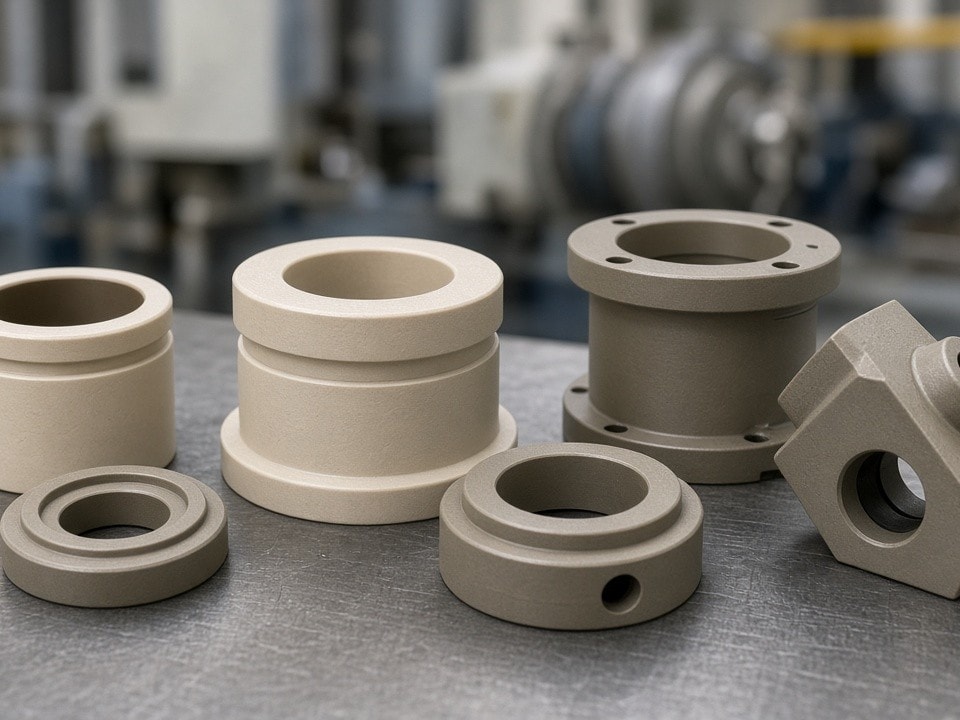
Virgin & Glass-Filled PEEK Components, Machined to Drawing
PartsMake manufactures precision PEEK components for equipment exposed to high temperatures, corrosive media and space-constrained assemblies. We machine virgin PEEK and reinforced grades, including PEEK-GF30 and carbon-filled PEEK-CA30, for engineering and procurement teams across the UAE, Saudi Arabia and the wider GCC.
Explore PEEK as a potential metal replacement when electrical insulation, lower weight, chemical resistance or low-friction performance matters. Send your drawing, material specification and operating conditions for a manufacturing review.
~260°C
Potential continuous service temperature, grade and design dependent
1–38 mm
Stated Swiss machining diameter envelope for small turned parts
±0.003 mm
Listed threshold for selected Swiss machining processes
Designed around your operating conditions
Share the temperature range, pressure, chemical media and electrical requirements so the material and manufacturing route can be reviewed against the actual application.
Material performance
PEEK for demanding service conditions
PEEK is a high-performance thermoplastic for applications where many standard engineering plastics may not be suitable. Depending on grade and design, it can tolerate continuous service temperatures up to approximately 260°C. Its wear performance and self-lubricating behaviour can help reduce friction in moving or sliding components.
PEEK can offer resistance to a range of chemicals, including some acids and alkalis, but compatibility is specific to the medium, temperature, concentration and exposure time. Confirm service conditions before final material selection.
Heat and friction
Thermal capability and self-lubricating behaviour can support selected hot-running or sliding components. Actual performance depends on grade, loading and part design.
Insulation or reinforcement
Virgin PEEK is unfilled and electrically insulating. Glass or carbon reinforcement can increase stiffness and reduce deformation, while changing machining behaviour and potentially electrical properties.
Considering a metal seal ring replacement?
PEEK may be considered where reducing component weight, adding electrical insulation or improving resistance to a compatible chemical environment is important. Before replacing a metal seal ring or structural feature, review stiffness, load, wear, thermal expansion, pressure and joining details.
Grade selection
Choose the grade for the job
Material selection should reflect mechanical, thermal, electrical and chemical duties. Grade names and properties can vary by manufacturer; specify the resin producer, grade designation, certification or approved equivalent in your RFQ.
| Material option | Typical selection reason | Key considerations |
|---|---|---|
| Virgin PEEK | Electrical insulation, chemical resistance and unfilled material properties | Often considered where insulation is needed and reinforcement is not required |
| PEEK-GF30 | Increased stiffness and reduced deformation under load | Glass reinforcement changes thermal expansion and machining response; confirm electrical requirements |
| PEEK-CA30 / carbon-filled PEEK | Higher stiffness and improved wear behaviour in selected designs | Carbon filler can make the material electrically conductive; do not assume suitability for insulating duties |
Application focus
Made for demanding industrial assemblies
PEEK parts can address specific design needs in GCC equipment exposed to heat, chemicals or vibration. Suitability must be checked against actual service conditions and applicable equipment specifications.
Downhole insulating joints
Electrical insulation and lower weight than a comparable metal component may support compact Middle East downhole assemblies. Specify temperature, pressure, fluid exposure and required dielectric performance.
Compressor valve plates
PEEK’s wear characteristics and thermal performance may suit selected special non-metallic valve plate designs. Review cycling, pressure differential and contact conditions.
Sensor probe covers
Machined PEEK covers can provide insulation and chemical resistance for explosion-protected sensor assemblies. Confirm the enclosure design and hazardous-area certification requirements with the responsible system designer.
Fluid handling and MRO
Custom bushings, seats, spacers, insulating parts and low-volume replacement components can be considered for compatible media and operating temperatures.
PEEK components do not, by themselves, certify an assembly for pressure service, downhole use or hazardous-area operation. The complete design and material selection remain subject to relevant engineering and certification requirements.
Manufacturing routes
Precision machining and moulding capabilities
We produce custom PEEK parts from customer drawings and specifications, supporting prototypes and repeat production. The right route depends on geometry, volume, fit requirements and lifecycle cost—not material price alone.
Discuss your manufacturing routeCNC milling, turning and Swiss machining
CNC processes support detailed profiles, bores, grooves, threads and sealing features. Swiss screw machining is available for small turned parts within the stated 1–38 mm machine envelope. Multi-axis machining can support complex geometries requiring access from several orientations.
Supplied capability data lists repeatable thresholds down to ±0.005 mm for selected milling and mill-turn processes and ±0.003 mm for Swiss machining. Achievable PEEK tolerances depend on geometry, grade, stock condition and inspection requirements; critical dimensions are reviewed before the production approach is confirmed.
Injection moulding for repeat batches
Engineering-polymer injection moulding includes PEEK for suitable part designs. Tooling and production plans are assessed against geometry, expected volume, wall thickness, finish and dimensional requirements. Rapid tooling may be considered for functional prototypes or lower-volume validation.
Controlled machining of reinforced grades
Glass- and carbon-filled PEEK can improve stiffness and load-bearing performance, while fibre reinforcement affects tool wear, edge quality and surface finish. Process and cutting approach are selected around the grade and feature requirements, with attention to clean edges, fit surfaces and dimensional stability.
Quality and documentation
Inspection agreed to your drawing and purchase order
Our industrial quality workflow can include dimensional inspection, material traceability and non-destructive or functional checks where appropriate to the part and project.
- ✓Dimensional inspection records, including CMM data books where geometry and scope require them.
- ✓Material documentation and traceability, subject to the supplied grade and procurement route.
- ✓PMI and testing records where applicable to the material and inspection plan.
- ✓Part identification, batch references and agreed packaging instructions.
State customer-specific inspection plans, approval requirements and documentation formats when requesting a quotation so availability can be confirmed before order placement.
Route selection
Machining, moulding or metal replacement?
Choose CNC machining
For prototypes, replacement components, complex one-off features or low-volume demand where tooling investment is difficult to justify.
Consider injection moulding
For repeat quantities and designs that can be adapted for mouldability. Review tooling cost, cycle requirements and annual demand together.
Assess PEEK in place of metal
Review weight, insulation, compatible chemical exposure, stiffness, load, wear, thermal expansion, pressure and joining details before changing a metal seal or structural feature.
For Gulf service, provide the actual temperature range and media. Heat, pressure and chemical concentration can materially affect suitability.
Prepare your RFQ
Help us return a useful quotation
Our engineers can flag material or drawing questions before production so the process, inspection scope and documentation are clear in the quotation.
- 012D drawing and 3D CAD file, including units and revision.
- 02Required grade: virgin PEEK, PEEK-GF30, PEEK-CA30 or approved equivalent.
- 03First-order quantity and expected repeat demand.
- 04Critical dimensions, tolerances, surface finish and inspection requirements.
- 05Operating temperature, pressure, chemical media and electrical requirements.
- 06Required certificates, traceability, marking and packaging.
- 07Delivery destination and requested schedule in the UAE, Saudi Arabia, Qatar or another GCC location.
Common questions
PEEK material and manufacturing notes
Can reinforced PEEK be used for insulating components?
Do not assume so. Virgin PEEK is unfilled and electrically insulating; glass or carbon reinforcement changes electrical properties. Confirm the selected grade against the required dielectric performance.
Is PEEK suitable for every acid or alkali?
No blanket compatibility should be assumed. Share the chemical medium, concentration, temperature and exposure time for review against the required grade.
Which is better for PEEK parts: machining or moulding?
The right route depends on quantity, geometry, fit requirements and lifecycle cost. CNC machining often suits prototypes and low-volume parts; moulding can be considered for suitable repeat-production designs.
Does a PEEK part certify a downhole or hazardous-area assembly?
No. Certification and service suitability apply to the complete design and remain subject to the relevant engineering and certification requirements.
Request a PEEK machining quotation
Send your drawing for a manufacturing review
PartsMake supports GCC procurement teams, MRO contractors, skid integrators and industrial system suppliers with custom polymer components and coordinated regional delivery options.
For a faster assessment, include the PEEK grade, operating environment, required quantity and delivery location in your enquiry.
Email: info@partsmake.ae
Company address: