
Precision machining for GCC engineering and MRO requirements
Mill-Turn Machining for Complex Precision Components
PartsMake provides mill-turn machining for GCC engineering firms, MRO contractors and industrial system integrators. One machining sequence combines turning, multi-angle milling and angled-hole drilling for demanding components.
9-axis
Twin-spindle platform with B-axis
±0.005 mm
Standard tolerance capability
10–15 days
Indicative DDP dispatch for suitable urgent parts
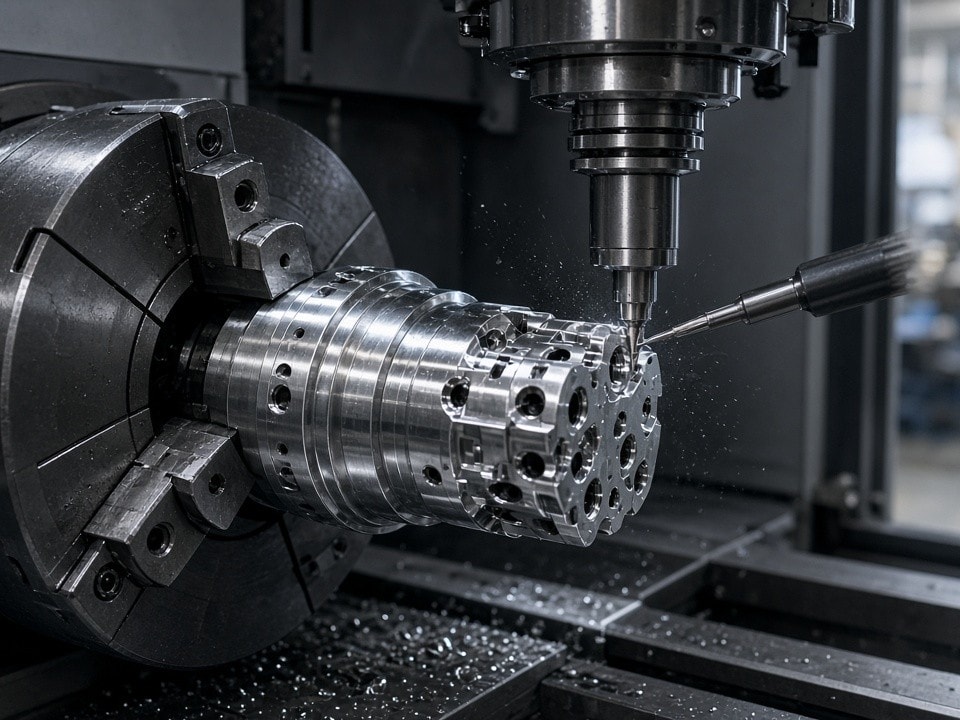
One setup. Multiple feature groups.
Turned diameters, milled faces and angled holes can remain aligned to a shared datum, reducing handling and the risk of accumulated error.
The mill-turn advantage
One setup for complex turning, milling and drilling
Mill-turn machining uses a CNC lathe platform with live tooling and multi-axis capability. Instead of transferring a component between separate turning and milling machines, several feature groups can be completed while the workpiece remains held in the machine.
01
Control the common datum
Maintain the relationship between turned diameters, milled faces and hole positions with fewer workholding changes.
02
Reduce cumulative error
One machining route means less handling, fewer transfers and lower risk of re-establishing the part incorrectly.
03
Shorten delivery routes
Complete more operations without waiting for separate machine capacity—valuable for urgent MRO replacement parts.
Turned features
Threads, grooves, shoulders, bores and precision diameters.
Milled details
Flats, slots, pockets and mounting faces.
Angular features
Cross-holes, angled holes, radial features and bolt patterns.
Practical fit
Best for rotational components requiring precise secondary features.
Machine capability
Built for complex precision components
Our primary mill-turn platform is configured for components that need turning and multi-angle machining in a single production sequence. Final tolerances depend on geometry, material condition and inspection method, so each requirement is confirmed during drawing review.
Need a different route?
Where size or geometry exceeds the mill-turn envelope, we review turning, multi-axis milling, grinding or EDM as appropriate.
| Machine configuration | 9-axis twin-spindle with B-axis |
|---|---|
| Maximum work envelope | Up to Ø420 mm × 1,050 mm long |
| Standard machining tolerance | Down to ±0.005 mm, subject to geometry and material |
| Surface finish | Down to Ra 0.4 μm, subject to feature and material |
| Typical materials | 316Ti, 17-4PH, Inconel 718 and Brass C360 |
| Heavy-duty CNC turning | Up to Ø850 mm × 2,200 mm |
| Inspection support | CMM, PMI and material traceability options |
Applications across the GCC
Complex workpieces made in one controlled sequence
The strongest fit is a component with rotational features and secondary features that must share a precise angular or positional relationship.
Middle East drilling instrument housings
Turned sealing diameters combined with milled connector features, slots or angled passages for demanding drilling equipment.
High-pressure hydraulic valve blocks
Precision bores and turned interfaces with cross-drilled or angled ports and milled mounting faces.
Precision locating pins and sleeves
Concentric diameters, shoulders and grooves held to a shared datum, with additional milled or drilled details where required.
Fluid manifolds and sensor housings
Compact parts with intersecting features that can be difficult to align through repeated setups.
Materials for demanding service
Machining aligned with the application
GCC components may operate in high temperatures, abrasive environments, seawater exposure or sour-service conditions. Material selection and machining strategy should follow the component specification.
- Stainless steels: 316Ti and related grades for housings, manifolds and fluid-handling components.
- 17-4PH: Precipitation-hardening stainless steel where strength and corrosion resistance must be balanced.
- Inconel 718: Nickel alloy for demanding thermal and mechanical applications.
- Brass C360: Suitable fittings, sleeves and precision turned components.
Inconel 625, Super Duplex 2507, Hastelloy C276 and Monel 400 may also be applicable through broader machining capabilities. Confirm the exact grade, condition and certification requirements in your RFQ.
Inspection and documentation
Evidence for procurement approval
Inspection and traceability records can support customer review and end-user documentation requirements.
CMM inspection is performed in temperature-stabilised facilities at 20°C ±0.5°C.
Select the right process
When mill-turn is the right route
We assess the drawing, quantity, material and critical dimensions before recommending a manufacturing route.
| Project requirement | Recommended route | Why |
|---|---|---|
| Turned diameters plus angled holes, flats or slots | Mill-turn machining | Fewer workholding changes |
| Valve block with intersecting ports and turned interfaces | Mill-turn or CNC milling | Based on access, datum strategy and envelope |
| Long, large-diameter mandrel with mainly turned features | Heavy-duty CNC turning | Supports up to Ø850 mm × 2,200 mm |
| Large plate, skid base or structural face | Gantry milling or fabrication | Better suited to large, non-rotational work |
| Very tight seal diameter or roundness requirement | Turning and cylindrical grinding | Grinding can achieve roundness down to 0.001 mm |
| Small, high-volume pins or shafts up to Ø38 mm | Swiss screw machining | Suited to small-diameter repeat production |
Urgent MRO support
Move from approved drawing to inspected component faster
When a delayed valve trim, pump shaft or drilling instrument housing holds up maintenance work, mill-turn production can reduce elapsed time by completing several operations without repeated machine transfers.
For suitable urgent components, indicative DDP dispatch to Dammam or Musaffah can target 10–15 business days. Actual timing depends on drawing approval, material availability, complexity, inspection scope and shipping arrangements.
GCC delivery coordination
We coordinate customs and delivery requirements, including relevant SABER/SASO processes for Saudi Arabia and site delivery options to Riyadh, Dammam, Dubai, Abu Dhabi, Doha and Jubail.
Start the review
Send the drawing and delivery requirement
Our team will review the manufacturing route, identify drawing or inspection questions and quote the scope against your required delivery date.
Discuss your componentRequest a quotation
Request a mill-turn machining RFQ
Send your 2D drawing or 3D model to info@partsmake.ae, or contact PartsMake by email or WhatsApp Business for technical clarification and drawing exchange.
Company address:
Email: info@partsmake.ae
WhatsApp Business:
Please include the material grade, quantity, critical dimensions, inspection requirements, required delivery date and destination, plus any end-user, packaging or customs documentation requirements.