
Custom fabrication for GCC industrial projects
Structural Enclosures & Skids
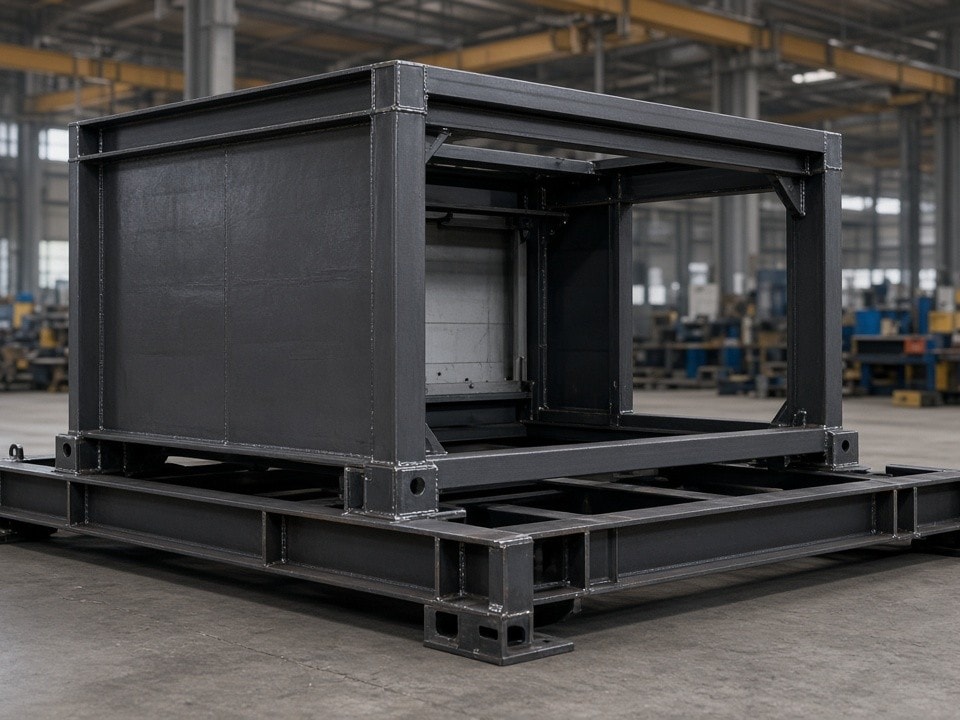
PartsMake manufactures welded structural enclosures and industrial skid assemblies for EPC contractors, system integrators and MRO teams across the UAE, Saudi Arabia and the wider GCC.
We cut, form, weld and machine steel and stainless components for outdoor equipment exposed to blowing sand, high temperatures and saline air. Send us drawings or a preliminary layout for a fabrication and RFQ review.
Up to 10 t
Welded workpiece capacity
6,000 mm
Maximum laser bed length
Desert and coastal environments
Fabrication details considered for blowing sand, high temperatures and saline air.
Welded assembly capability
Coordinate panels, frames, supports and skid structures to approved drawings and scope.
Project-aligned inspection
Agree material records, inspection points and weld requirements before production.
Designed around the service environment
Built for desert, coastal and process-site conditions
An enclosure or skid is only as dependable as its interfaces. Sand may enter through poorly designed louvers and door gaps; coastal salt can attack unsuitable finishes; vibration and lifting loads can distort frames or affect equipment alignment.
We plan fabrication around the site conditions and the equipment mounted inside. Depending on the design, this can include formed gasket grooves, protected openings, reinforced mounting points and corrosion-resistant material or finish choices.
Dual sealing paths
For suitable designs, formed dual gasket grooves support controlled sealing paths. Panel flatness, weld distortion and door alignment also matter at the gasket interface.
Protected airflow openings
Protective louver assemblies can be designed around airflow, access and maintenance needs, with sand and insect ingress considered in the opening layout.
Corrosion-aware choices
Material and finish selection can reflect site exposure, process conditions, structural loads and the project specification.
Load paths considered
Lifting points and frame details are reviewed against the lift cases and equipment information supplied, with engineering confirmation identified where needed.
IP66 / IP67
Review of enclosure details for specified outdoor protection requirements.
NEMA 4X
Design and fabrication details considered against the required classification.
Ratings require assessment
IP ratings and NEMA classifications are different standards. The completed enclosure must be tested and assessed against the specified standard and configuration.
From component to welded assembly
Enclosure and skid fabrication capabilities
Our sheet metal and structural fabrication services cover custom panels, equipment housings, support frames and skid structures. Components can be manufactured individually or coordinated as a welded assembly to approved drawings and scope.
| Process | Available capacity | Typical application |
|---|---|---|
| Fibre laser cutting | Bed up to 6,000 × 2,500 mm; carbon steel up to 35 mm, stainless steel up to 30 mm and aluminium up to 25 mm | Panels, brackets, base plates, vents and mounting details |
| CNC press-brake forming | Bending length up to 6,000 mm; plate thickness from 0.8 to 16 mm | Enclosure walls, doors, channels, covers and formed profiles |
| Industrial welding and cladding | Workpieces up to 10 metric tons; sheet to heavy plate over 50 mm | Frames, skid bases, supports and welded modules |
| Large gantry milling | Work envelope up to 3,500 × 2,200 × 1,000 mm | Machined mounting faces, large base plates and tube sheets |
Welding requirements
Welding can be specified to applicable project requirements, with ASME Section IX and AWS D1.1 or D1.6 processes available. Structural weld quality can be controlled to ISO 5817 Level B where required by the agreed scope.
Enclosures for outdoor equipment
Sealing details and sand-resistant airflow
Where an outdoor enclosure is designed around IP66, IP67 or NEMA 4X requirements, we can review the sheet-metal design and fabrication details that support the intended protection level. This may include door geometry, gasket compression, cable-entry locations, drainage provisions and access-panel interfaces.
For ventilation, louver geometry, mesh or screen selection, free area and cleaning access should be defined against the equipment heat load and maintenance plan. The vent design must be assessed as part of the complete enclosure when ingress protection is specified.
Specify the required rating and test method
A protection rating is not guaranteed by fabrication alone. Identify the required standard, configuration and any project-approved test method in your RFQ.
Suitable outdoor integrations
- 01Outdoor solar inverter and electrical equipment housings
- 02Water-treatment and seawater reverse-osmosis skid structures
- 03Chemical injection and process equipment skids
- 04Switchgear supports, pump, filtration and instrumentation assemblies
Share the equipment arrangement, operating loads and installation constraints to help define the proposed build scope.
Skids, lifting points and fit-up
Review load paths before fabrication
Skids and enclosures may be lifted during workshop handling, transport and site installation, with different load cases on the frame, welds and lifting lugs. We review lifting-point locations and load paths against the lift cases and equipment information provided, and can identify details requiring engineering confirmation.
For larger assemblies, welding capacity supports workpieces up to 10 metric tons. Where the design requires it, welded fabrication can be coordinated with large-format machining for flat mounting surfaces or controlled equipment interfaces.
Include these details in your lifting review
- Assembly weights
Empty and operating weights, where available.
- Centre of gravity
Lifting orientation and equipment arrangement.
- Lifting configuration
Number and position of lifting points.
- Load cases
Transport, installation and dynamic load factors.
- Equipment interfaces
Mounting loads and interface drawings. Agree the responsible engineering party and approval process where stamped calculations or third-party approval are required.
Materials and corrosion protection
Match material and finish to the site
Material selection depends on site environment, structural loads, process exposure and project specification. Fabrication capabilities include carbon steel, stainless steel and aluminium work, with machining and material options across grades such as SS304/316 and structural carbon steel.
For coastal or chemically exposed service, the specification may call for stainless steel, a suitable protective coating or another corrosion-control system. Fabrication and specified surface treatment can be coordinated within the agreed supply scope.
Salt-spray evaluation
Corrosion-resistant finishes can be evaluated in ASTM B117 salt-spray testing, with chamber exposure available up to 2,000 hours.
Define the test duration and acceptance criteria for the project.
Quality records and inspection options
Align inspection with the purchase order
Inspection and material documentation can be matched to purchase order and project requirements. Identify hold points, witness points, weld maps, inspection reports and data-book requirements before production to align records with the end user’s review process.
Dimensional control
Dimensional inspection and CMM measurement for defined critical features.
Material traceability
EN 10204 3.1 material certificates linked to heat or lot identification.
Material verification
PMI by XRF or OES where specified.
NDT options
PT, MT and UT through qualified inspection personnel.
Pressure testing
Hydrostatic pressure testing up to 20,000 psi (1,380 bar), when applicable to the assembly.
Weld inspection
Requirements agreed against the drawing and applicable code.
Plan a clear RFQ
What to share for a faster review
This work suits high-mix, low-volume industrial projects where equipment layouts, interfaces or environmental conditions vary by package. Drawings or a marked-up layout help us review process selection and quotation scope.
Send drawings for review- Drawings, revisions or a marked-up layout
- Material grade and specified finish
- Required protection level and test method
- Quantity and target delivery date
- Operating environment and equipment loads
- Inspection documents and project hold points
GCC delivery planning
Let us know if the project needs DDP delivery to a site in Riyadh, Dammam, Jubail, Dubai, Abu Dhabi or another GCC location.
Common project questions
Technical notes for your specification
Can fabrication alone confirm an IP or NEMA rating?
No. The finished enclosure must be tested and assessed against the specified standard and configuration. IP ratings and NEMA classifications are different standards, so specify the required rating and approved test method in the RFQ.
What should we define for protective louvers?
Share the equipment heat load, airflow requirement, access constraints and maintenance plan. Louver geometry, mesh or screen selection, free area and cleaning access should be assessed as part of the complete enclosure when ingress protection is specified.
What information helps review lifting points and skid loads?
Provide assembly weights, centre of gravity, lifting orientation, lifting-point positions, load factors, equipment mounting loads and interface drawings. Agree the responsible engineering party and approval process if stamped calculations or third-party approval are required.
Request a fabrication review and RFQ
Send your enclosure or skid package
Email info@partsmake.ae with the subject line Structural Enclosures & Skids RFQ. Include drawings, revisions, quantities, required inspection documents and any applicable IP or NEMA test requirements.
Our team can review the package and respond with scope questions, manufacturability feedback and a quotation. For project correspondence or supplier documentation, contact us at .
For a quick drawing clarification, include your preferred contact method and the best time to reach your team.
Make an enquiry
Share your project details and drawings with our team.