
Metal additive manufacturing · UAE & GCC
Metal PBF-LB printing for complex industrial components
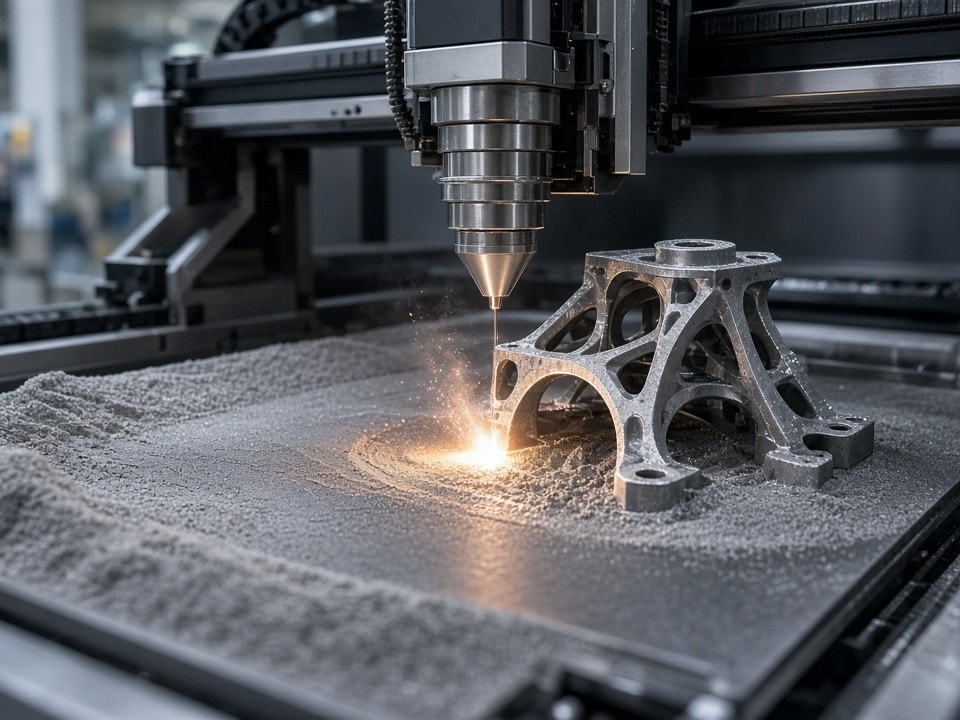
Laser powder bed fusion (PBF-LB), also known as selective laser melting (SLM), helps engineering teams produce intricate metal parts, integrated internal features and lightweight structures that are difficult to machine conventionally.
At PartsMake, we print Ti-6Al-4V (Ti64), Inconel 718 and 316L stainless steel on an industrial build platform up to 400 × 400 × 450 mm. The service supports prototypes, replacement parts and low-volume production for oil and gas, water, energy and aerospace-related applications.
400 × 400 × 450
Maximum build envelope, mm
20–60 μm
Typical layer thickness
3 alloys
Ti64, Inconel 718, 316L
Process overview
Metal PBF-LB capabilities
A laser selectively fuses metal powder layer by layer. The process is suited to parts where internal passages, consolidated assemblies or geometry-led weight reduction offer a clear design advantage.
Plan critical features before build
As-built accuracy is not a substitute for a drawing tolerance. For fits, sealing faces, threads, bearing seats and other critical features, we review print allowance and the machining plan before manufacture.
Process specifications
| Process | Laser powder bed fusion (PBF-LB / SLM) |
|---|---|
| Maximum build envelope | 400 × 400 × 450 mm |
| Typical layer thickness | 20–60 μm |
| As-built dimensional accuracy | Approximately ±0.05 to ±0.1 mm; geometry-dependent |
| Available materials | Ti-6Al-4V, Inconel 718 and 316L stainless steel |
| Follow-on services | CNC machining, dimensional inspection and specified post-processing |
Engineering applications
Designed around the challenge, not just the print
We review geometry, operating conditions, build strategy and verification needs together so the manufacturing route is practical for the intended application.
Oil & gas · MWD and downhole components
Conformal cooling channels inside a short-sub
Measurement-while-drilling tools work in restricted spaces and demanding thermal conditions. For a proposed MWD short-sub or instrument housing, PBF-LB can form cooling passages that follow the component’s internal profile and may consolidate selected geometry into a single printed body.
Design review
We assess channel cross-sections, powder evacuation paths, wall thicknesses, support access and the relationship between passages and critical interfaces.
Verification planning
Before release, we consider whether channels can be built and cleaned reliably, and whether their location suits machining and inspection. Pressure or leak testing can be scoped to the project specification where required.
An internal passage is not production-ready solely because it appears in CAD: manufacturability and a suitable verification method must also be established.
Aerospace-related · UAV structures
Lightweight brackets with integrated lattice structures
For drone airframe bulkheads, equipment mounts and structural brackets, PBF-LB can combine features into one component and place lattice structures in suitable regions to reduce mass while retaining material around attachment points and load paths.
- 01Review expected loading, mounting interfaces, minimum feature sizes and build direction.
- 02Design open lattice cells to be printable, cleanable and inspectable, with powder removal access.
- 03Retain solid sections at highly stressed interfaces where needed, and machine contact surfaces as specified.
Ti-6Al-4V is available where its strength-to-weight characteristics suit the design. We can also assess whether a printed part is a better fit than a multi-piece assembly—or whether conventional machining or fabrication is more appropriate.
Material selection
Choose the alloy for the service conditions
The right material depends on operating temperature, loading, corrosion exposure, surface requirements and the applicable project specification. Final suitability should be confirmed against service conditions and any governing operator or customer requirements.
Ti-6Al-4V (Ti64)
Weight-sensitive designs
Consider for selected structural components, including UAV brackets and instrumentation supports.
Inconel 718
Elevated-temperature service
A high-temperature nickel-based alloy option, subject to service conditions and specified post-processing.
316L stainless steel
Industrial components
Consider for corrosion-resistant parts where its properties meet the application requirements.
Compare the complete manufacturing route
PBF-LB is not automatically the most economical choice. Simple prismatic parts, components larger than the build envelope or designs with extensive machining stock may suit CNC machining, sheet metal fabrication or another process better. We can compare viable routes during quotation review.
Post-processing
Manage residual stress and finishing requirements
Thermal history during PBF-LB can create residual stress. The appropriate post-build route depends on the material, geometry, performance requirements and applicable specification.
Stress relief and HIP, as specified
Hot isostatic pressing (HIP) can be considered to address internal porosity and support required material properties. HIP is not automatic or represented as an in-house operation: availability, scope, material condition and documentation requirements are confirmed during RFQ review.
Potential follow-on operations
Support removal & finishing
Support removal and surface finishing can be included according to the part and agreed scope.
CNC machining
Machine interfaces and tolerance-critical features to the agreed drawing requirements.
Dimensional inspection
Dimensional verification, including CMM measurement where appropriate.
Material documentation
Material identification and documentation as agreed for the order.
HIP does not remove the need to define design requirements, inspection criteria or acceptance standards. Include any mandated heat treatment or post-build condition in your RFQ so it can be agreed before production.
Quality & delivery
Inspection and traceability for GCC projects
Documented quality checks and traceability can be scoped to the part and order. State the required inspection method and acceptance criteria in your RFQ so we can confirm applicability to the printed component.
Dimensional and material checks
Temperature-stabilised CMM inspection and PMI by XRF/OES are among the available quality resources.
NDT and testing
Level II capabilities include PT, MT, UT and hydrostatic testing, subject to the agreed scope.
Material certification
Material and inspection documentation can include EN 10204 3.1 material certification where applicable.
Regional coordination
Delivery options can be coordinated for Dubai, Abu Dhabi, Riyadh, Dammam, Jubail and Doha.
Confirm documentation requirements for printed material, heat treatment, HIP and finished-part inspection before order placement. DDP delivery, customs coordination and applicable SABER/SASO or MoIAT requirements can be reviewed for the destination and product classification.
Route assessment
Is metal PBF-LB right for your part?
PBF-LB is worth evaluating when geometry brings a measurable functional benefit.
- ✓Internal passages that are difficult or impossible to machine
- ✓Several components that may be consolidated into one
- ✓Lattice or topology-optimised features with a defined weight objective
- ✓Low-volume or replacement parts where conventional tooling is impractical
A different process may be better for large or geometrically simple components, high volumes, or parts where conventional manufacturing can meet tolerance or surface requirements more efficiently. We assess machining and inspection as part of the complete route—not the print in isolation.
Common project questions
Plan a manufacturable part
Can internal channels be printed and verified?
We review passage geometry, powder evacuation and cleaning access, then establish a suitable inspection or pressure/leak test method against the project specification where required.
Does every metal print require HIP?
No. Stress relief, HIP and any subsequent heat treatment depend on material, geometry, performance requirements and the applicable specification. Agree the required route and documentation before production.
What should I include in a quotation request?
Share a 3D CAD file and drawing with critical tolerances, preferred alloy and material specification, operating environment, loads and temperature range, quantity, target delivery date, post-processing and inspection needs, and delivery location.
Request a quotation
Send us your drawing or 3D model
We will review geometry, build envelope, material, post-processing route and inspection scope, then return a quotation or request clarification.
For engineering discussions or drawing exchanges, contact us at info@partsmake.ae. Our address is .
A complete RFQ helps us assess the right manufacturing route from the outset.
Information to share
- 013D CAD file and drawing with critical tolerances
- 02Preferred alloy and applicable material specification
- 03Operating environment, loads and temperature range
- 04Required quantity and target delivery date
- 05Post-processing, HIP, inspection and documentation requirements
- 06Delivery location and customs or end-user requirements