
Engineering polymers for GCC industry
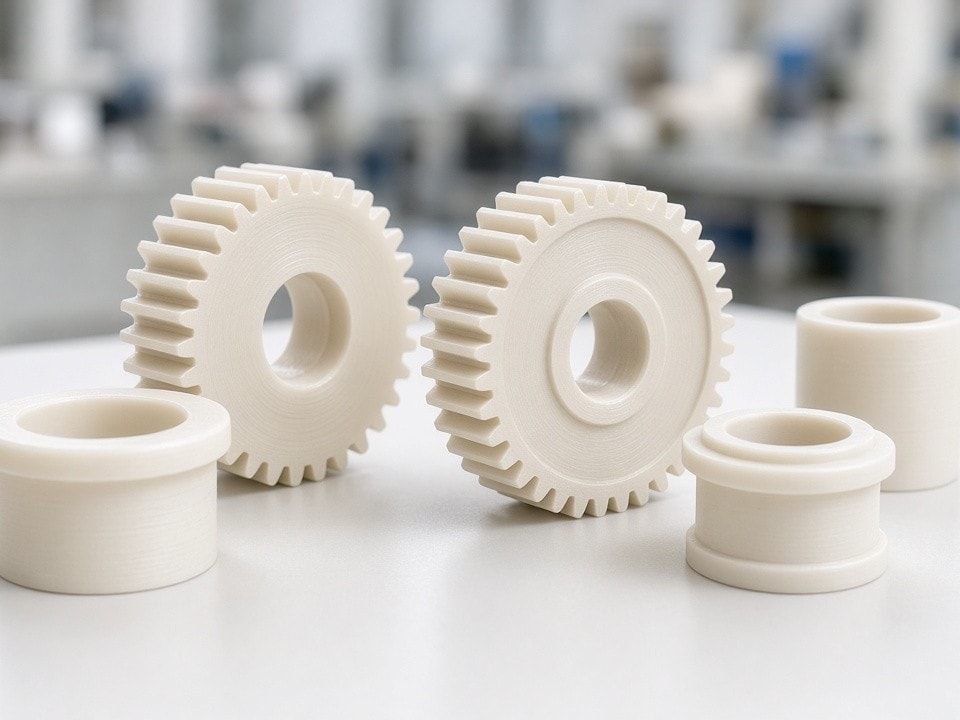
POM-C & Industrial Nylon Parts for GCC Applications
Custom-machined and moulded POM-C and industrial nylon components for hot, dry and dusty operating environments across the UAE, Saudi Arabia, Qatar and the wider GCC.
From desert conveyor rollers and wear blocks to insulating supports for large-diameter pipelines, we review the part, fit and operating conditions before recommending a practical material and manufacturing route.
Have a drawing or sample? Share it with PartsMake for a practical review.
7–14 business days
Published first-shot lead time for rapid prototype tooling
Up to 1,200 × 1,000 × 800 mm
Published 5-axis milling envelope; part suitability is confirmed by geometry
Ø850 × 2,200 mm
Published turning envelope, subject to material form and fixturing
GCC delivery support
Air or sea freight, with DDP quotations available subject to destination
Material selection
Choose for the wear surface and the service conditions
POM-C and industrial nylon can suit rigid structural parts and sliding wear surfaces. In dry, dusty service, the right option depends on load, speed, temperature, fit and the way sand reaches the contact interface—not simply the polymer name.
Precision and dimensional stability
POM-C (acetal copolymer)
A candidate for dimensionally stable machined components, precision sliding parts, bushings and low-friction wear surfaces.
Review: load, contact pressure, operating temperature and chemical exposure.
Toughness and mechanical loading
PA6 / PA66 industrial nylon
Options for wear parts and components exposed to impact or sustained mechanical loads, subject to the selected grade and application.
Review: moisture absorption can affect dimensions and fit; confirm temperature, load and grade.
Large or specialised wear parts
MC cast / oil-filled nylon
A cast grade may suit larger or low-friction components, depending on geometry and service conditions.
Review: grade availability, machining allowance, dimensional movement and application compatibility.
POM-C and PA66 are within our stated rapid tooling and engineering polymer capabilities. PA6 and MC oil-filled or cast nylon grades are subject to grade and supply confirmation during quotation. Include any required specification, brand or material standard in your enquiry.
Wear parts and structures
Parts made around your equipment
We support replacement-part orders, equipment modifications and new designs for contractors, integrators and industrial distributors.
Discuss a part with our teamDesert conveyor rollers
Custom-bored or profiled components for conveyor systems exposed to dust and abrasive particles.
Wear strips and sliding blocks
Replaceable contact surfaces for guides, chutes, handling equipment and machinery.
Bushes, spacers and insulating components
Made to drawing for assemblies requiring a non-metallic component.
Large-pipeline external supports
Polymer saddles, spacers or supports designed to separate a pipe from a structural support and provide electrical insulation where specified.
Custom moulded parts
For repeat orders where the part geometry and forecast volume justify dedicated tooling.
Pipeline support review: We assess the intended pipe load, contact area, movement, temperature and installation details. Polymer supports can provide electrical separation, but the final assembly’s electrical and structural requirements must be verified by the project design authority.
Manufacturing route
From replacement part to repeat production
The process is selected around part size, tolerance requirements, quantity and expected demand. We can also review a staged route: machine initial parts for fit and function, then assess tooling for repeat production.
Prototypes, small batches and replacements
CNC machining
Often a practical choice for one-offs, design revisions and parts that need to match an existing component. Turned and milled polymer parts can include complex profiles and features requiring accurate alignment.
Equipment includes multi-axis CNC milling, CNC turning, mill-turn and Swiss screw machining. Published envelopes include 5-axis milling up to 1,200 × 1,000 × 800 mm and turning up to Ø850 × 2,200 mm. The suitable envelope and achievable tolerances depend on part geometry, fixturing and material form and are confirmed against the drawing.
Repeatable parts and production batches
Rapid tooling and injection moulding
Rapid tooling can reduce the time and investment needed to move from design to moulded parts. Prototype tooling includes POM-C and nylon grades such as PA66 with glass fibre, subject to part and grade suitability.
Published first-shot lead times are 7–14 business days. Final timing depends on tool complexity, design approval, material availability and sampling. Other listed engineering polymer moulding capabilities include clamp forces from 80 to 850 tonnes and part weights up to 3,200 g, depending on material and tool design.
Application review
Designed for dry, dusty service—not assumed to be maintenance-free
Desert sites can combine airborne sand, high ambient temperatures and limited access to lubrication. In suitable applications, polymer wear components can help reduce metal-to-metal contact and may operate with little or no added lubrication.
Performance still depends on load, speed, alignment, heat build-up and abrasive conditions. POM-C and nylon are not interchangeable, and a material name alone cannot guarantee service life. For critical applications, validate the design under representative operating conditions before specifying a production batch.
What we assess before recommending a grade
-
Friction and wear
Contact pressure, sliding speed, surface finish and whether the mating surface is metal or another polymer.
-
Sand and dust exposure
Whether particles may become trapped at the wear interface, and how the part can be inspected or replaced.
-
Fit and mechanical loading
Clearance, thermal expansion, moisture effects, static and dynamic loads, impact, creep and support conditions.
-
Environment and maintenance
Temperature, UV exposure, chemicals, cleaning agents and outdoor ageing where relevant.
Inspection and records
Quality, documentation and GCC delivery
Parts are checked against agreed drawings and inspection requirements. Quality resources include temperature-controlled CMM inspection, material identification and non-destructive testing for applicable products.
For polymer orders, we confirm the relevant inspection method and available material documentation with the quotation. EN 10204 3.1 certification applies to metallic materials and is not represented as a standard polymer certificate.
Coordinated regional shipments
Air or sea freight can be coordinated, with DDP delivery quotations available for locations including Riyadh, Dammam, Jubail, Dubai, Abu Dhabi and Doha, subject to destination and shipment details.
Where local conformity or customs requirements apply, we confirm the documentation route before dispatch.
Ask about delivery and documentationQuotation checklist
Send what you have—even if the design is still in progress
We can clarify missing details during the review. These five points help us assess the part and prepare a useful quotation.
-
01
Part file
2D drawing, 3D CAD file or a clear photograph of a sample part.
-
02
Material requirement
POM-C, PA6, PA66, MC cast nylon or a specified grade; tell us whether alternatives are acceptable.
-
03
Operating conditions
Load, speed, temperature, dust exposure, lubrication and mating surface.
-
04
Order details
Quantity, prototype or production status, target delivery date and delivery city.
-
05
Inspection needs
Critical dimensions, tolerances, material records, marking or packaging instructions.
We’ll review your files, flag material or design questions and provide a quotation with the proposed process, lead time and documentation scope.
FAQs
Common questions about POM-C and industrial nylon
Should I use POM-C or nylon for a dry-running wear part?
POM-C is often considered for dimensionally stable, low-friction components. Nylon can be a strong option where toughness and wear resistance are priorities. The choice depends on load, speed, heat, fit and exposure conditions. Share your application details and we’ll review the trade-offs.
Can you make large nylon or POM-C pipeline support parts?
We can review custom polymer supports against your drawing, load case and required material. Include the pipe size, support geometry, operating temperature and any electrical isolation requirements. Material and process availability are confirmed before quotation.
Do you supply MC oil-filled nylon?
MC cast nylon and oil-filled grades are subject to material availability and specification review. Include the grade or supplier designation, part drawing and service conditions so we can confirm a suitable route.
Can you replace a worn component without a CAD model?
Yes. A sample part, photographs and key measurements can help us assess it. A production replacement may require additional dimensions or formal drawing approval before manufacture.
What affects price and lead time?
Material grade, part size, machining time, mould or fixture requirements, tolerances, quantity, inspection scope and delivery destination all affect the quotation. A drawing and target quantity are the quickest way to receive a useful estimate.
Request a quotation
Send your drawing to PartsMake
Share your CAD files, sample details or application requirements. We’ll help assess whether POM-C, industrial nylon or another grade is a practical fit for your operating conditions.
For a faster review, include the required quantity, key operating conditions and delivery location.